

11 Small Bedroom Layout Ideas For Better Sleep And Comfort
TLDR: Most people looking for better sleep reach for a new mattress or a sleep supplement before they ever look at their bedroom layout. But Harvard Medical School experts confirm that light, airflow, and furniture placement all directly influence how the body moves through sleep stages. A small bedroom that’s laid out poorly — wrong bed position, harsh lighting, visual clutter, blocked ventilation — quietly undermines rest every night without you realizing it. These eleven layout ideas fix the specific problems that make compact bedrooms harder to sleep in.
One in three adults in the United States doesn’t get enough sleep, according to Healthy People 2030, a national initiative led by the U.S. Department of Health and Human Services. Most of the conversation around that statistic focuses on screens, stress, and sleep schedules. Almost none of it focuses on the physical environment people are trying to sleep in.
That’s a gap worth closing. Bedroom layout affects sleep quality through several direct mechanisms: how safe and settled the sleeping position feels, how much visual stimulation the brain is processing before sleep, how well air circulates through the night, and how much ambient light reaches the sleeping area.
None of these require expensive fixes. Most require only a rethought furniture arrangement.
Here’s what the research and design experts actually recommend.
1. Place the Bed in the Command Position
Bed placement is the single most impactful layout decision in a bedroom, and it’s where most compact bedrooms get it wrong by defaulting to whatever fits rather than what actually supports rest.
The concept designers and feng shui practitioners consistently return to is the “command position” — placing the bed diagonally across from the door so you can see the entrance while lying down, without being directly in line with it. The headboard sits against a solid wall, not a window or an open space.
This isn’t purely philosophical. Feng shui expert Suzanne explains the practical logic: “You need to feel secure in the bedroom and this means positioning the bed in what’s known as the ‘command position.’ When you are in bed you can see the door and are immediately aware if it opens. Psychologically, this gives you reassurance that you are safe and this makes it easier to achieve quality sleep.”
Common errors to avoid include placing the bed directly in line with the door — sometimes called the “coffin position” — and pressing the bed into a corner, which restricts movement and can subtly affect the sense of ease in the room. For small bedrooms specifically, the recommendation is clear: headboard against a solid wall, diagonal sightline to the door, clear floor space on at least one side.
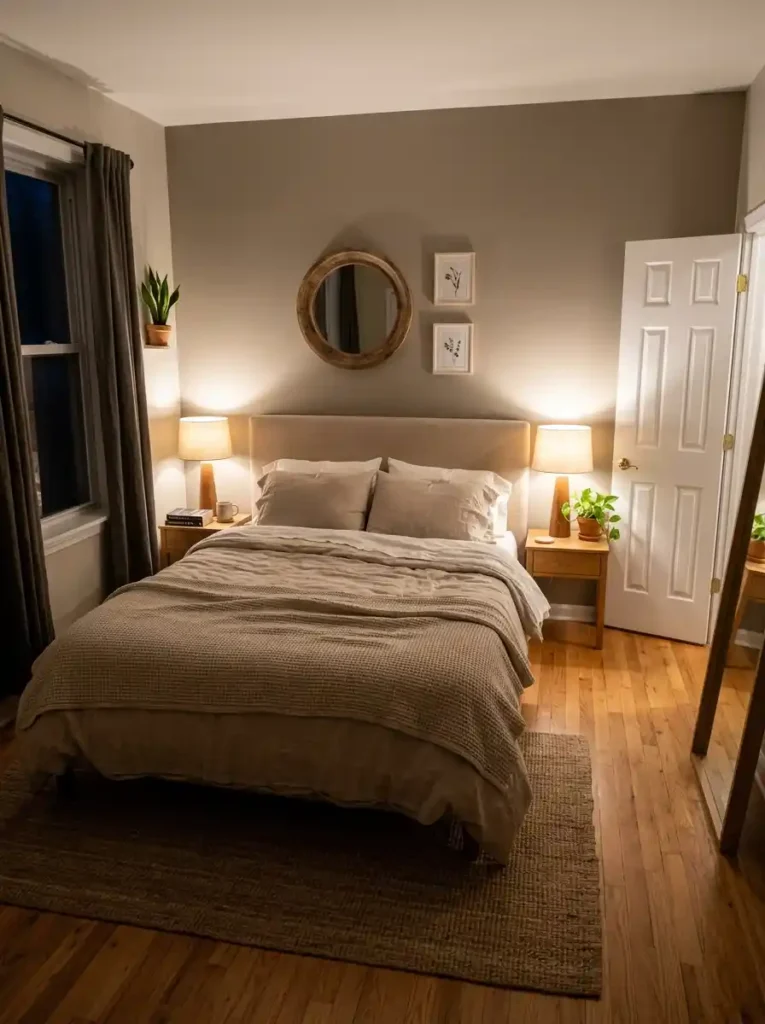
2. Keep Clear Walking Paths Around the Bed
Leaving space on both sides of the bed allows for easy movement and makes the room feel open and comfortable. Symmetry and balanced sightlines improve the feel of the space. The standard that most interior designers work from is 24 to 30 inches of clear floor space on at least one side, and ideally both.
Below that threshold, nightly movement — getting up in the night, morning routines, making the bed — becomes a repeated small friction that builds into background stress. Most people don’t consciously register it, but the body does.
In a compact bedroom where 24 inches on both sides isn’t achievable, the priority is one fully clear path on the side you use most frequently, combined with wall-mounted nightstands and slimmer furniture that doesn’t push into the remaining clearance.
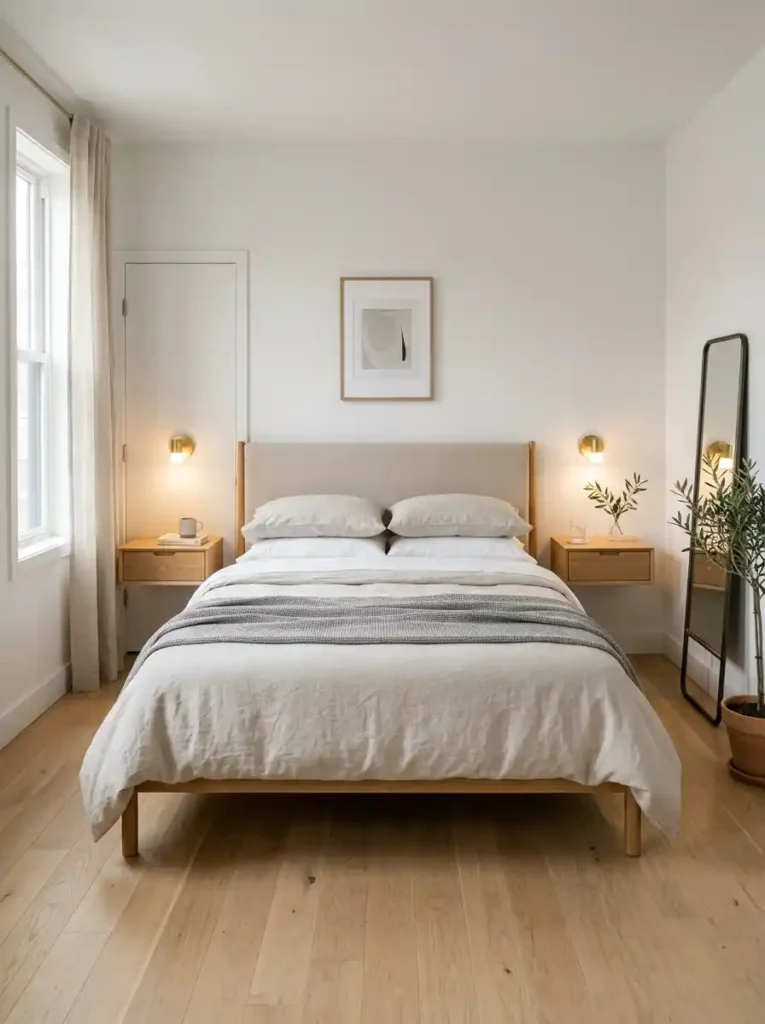
3. Remove Overhead Lighting From the Sleep Environment
Harsh overhead lights signal your brain to stay awake. Soft lighting helps your body prepare for bedtime. This is a basic circadian biology point — the brain reads broad bright light overhead as daytime, which suppresses melatonin production and delays sleep onset. It applies regardless of the time on the clock.
Even small amounts of light — like a digital clock — can reduce melatonin by 50%, according to NIH research from 2024. A harsh ceiling light while winding down for the evening is significantly more disruptive than most people account for.
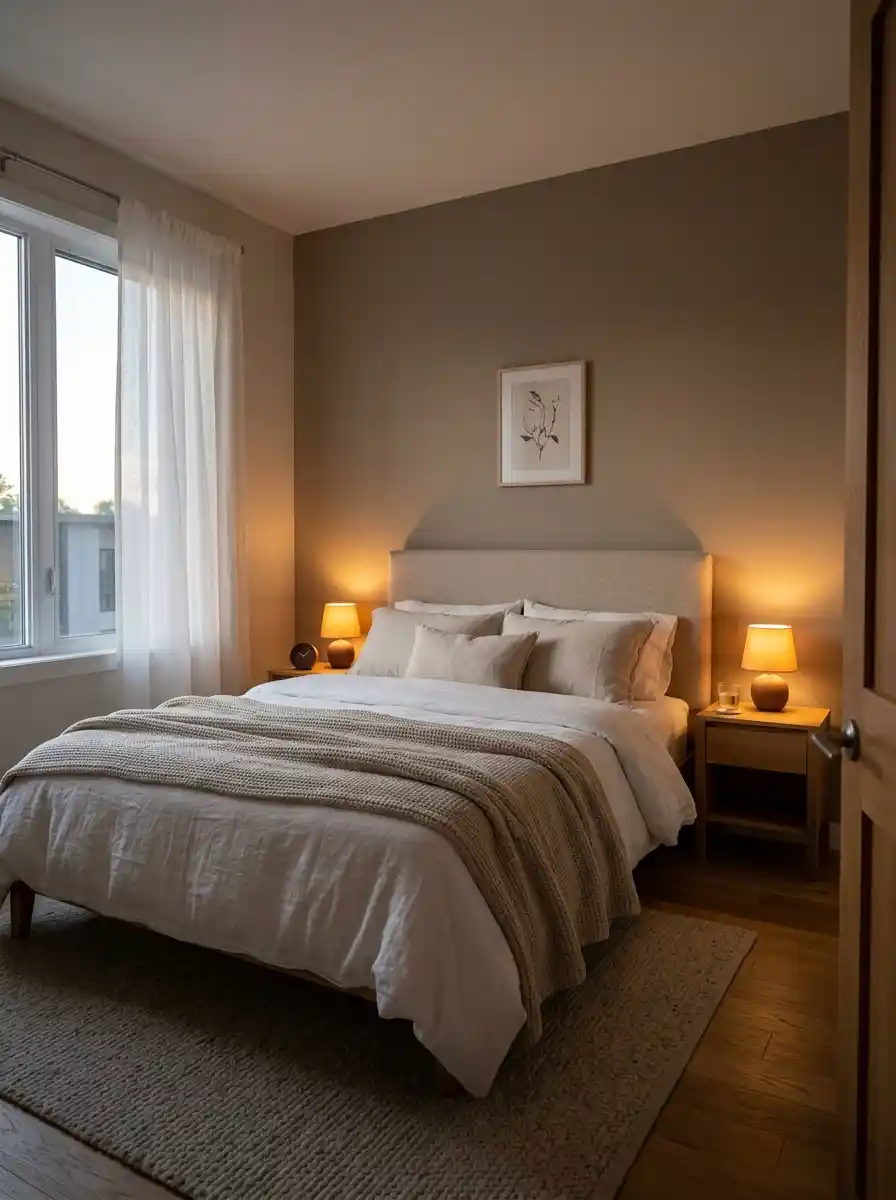
The fix is straightforward: warm-toned bedside lamps (2200K to 2700K) positioned at nightstand height rather than overhead, with the ceiling light either dimmed or switched off entirely in the hour before sleep. Smart bulbs that shift from daylight (5000K) in the morning to a warm candlelight tone (2200K) at night make this automatic without requiring any habit change.
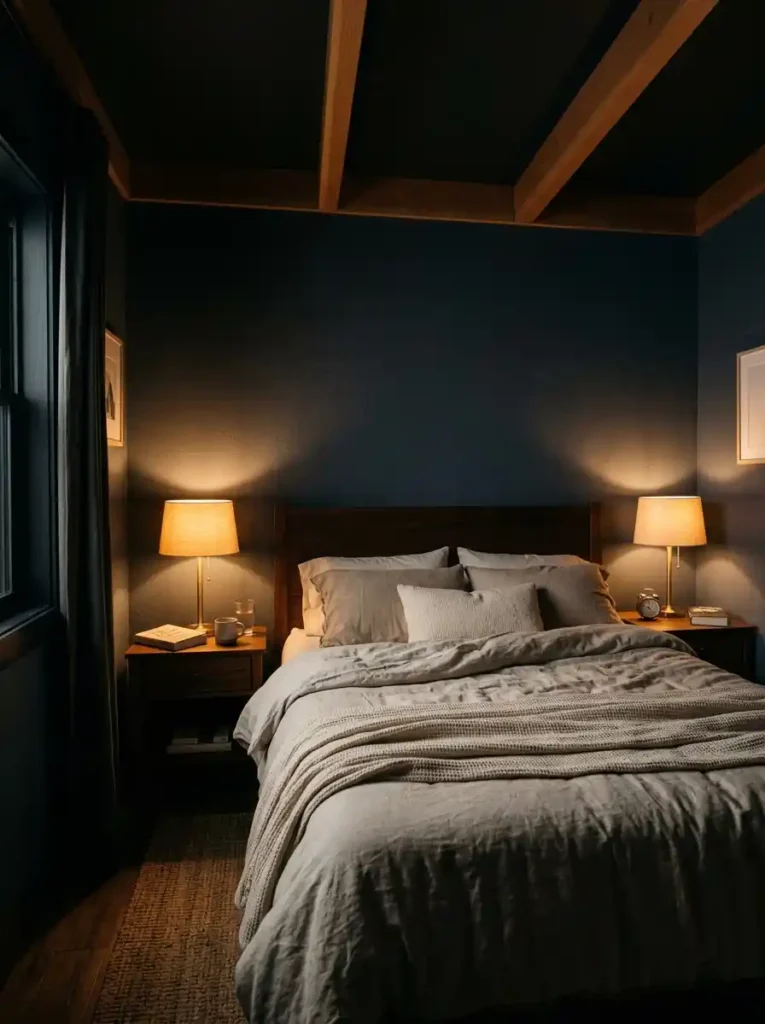
4. Separate the Sleep Zone From the Work Zone
Working from a bedroom is a reality for a large portion of apartment dwellers. The sleep problem it creates isn’t the desk itself — it’s the sightline from the bed to the work area.
When a laptop, desk, or visual cues of unfinished work are in direct view from the pillow, the brain maintains a low level of task-related alertness that makes it harder to fully transition into rest mode. Sleep researchers describe this as conditioned arousal — the brain associates the physical environment with wakefulness and activity rather than sleep.
Practical separation in a small bedroom doesn’t require a partition. Positioning the desk out of the bed’s direct sightline — behind the headboard wall, in a corner that faces away from the bed, or screened by a low bookcase — is usually enough. Closing the laptop and storing it in a drawer or bag at the end of the workday removes the visual cue entirely even when desk separation isn’t possible.
Phones, tablets, and TVs emit blue light that disrupts melatonin. More people are creating tech-free bedrooms in 2026 — a direction that tracks directly with what sleep research has consistently shown for the past decade.
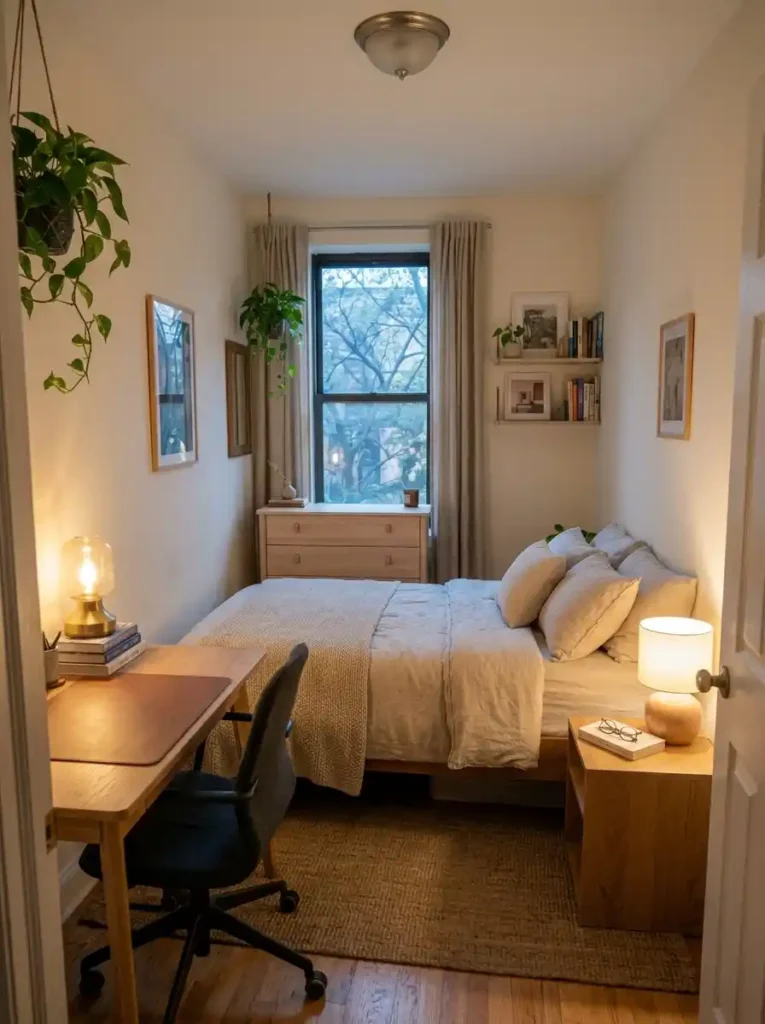
5. Keep the Window Accessible for Airflow and Morning Light
Bedroom ventilation is more directly tied to sleep quality than most people realize. A 2025 review published in Indoor Air — synthesizing research from 2020 to 2024 — found that inadequate ventilation in bedrooms, particularly CO2 buildup from sleeping occupants, leads to disturbed sleep. The research suggests that CO2 levels should remain below 1,000 ppm, and preferably below 800 ppm, during sleep.
In practical bedroom layout terms, this means keeping furniture away from windows and ventilation points so that air can move freely. A tall wardrobe or bookcase pushed against the only window doesn’t just block light — it reduces the airflow that keeps the sleeping environment fresh through the night.
Morning light exposure matters on the other side of this equation. Natural light in the first hour after waking helps reset the circadian rhythm and supports better sleep the following night. A bedroom layout where morning light reaches the sleeping area — through sheer rather than blackout curtains, or with the bed positioned to catch early light — supports this naturally.
6. Clear Visual Clutter From the Sleeping Area
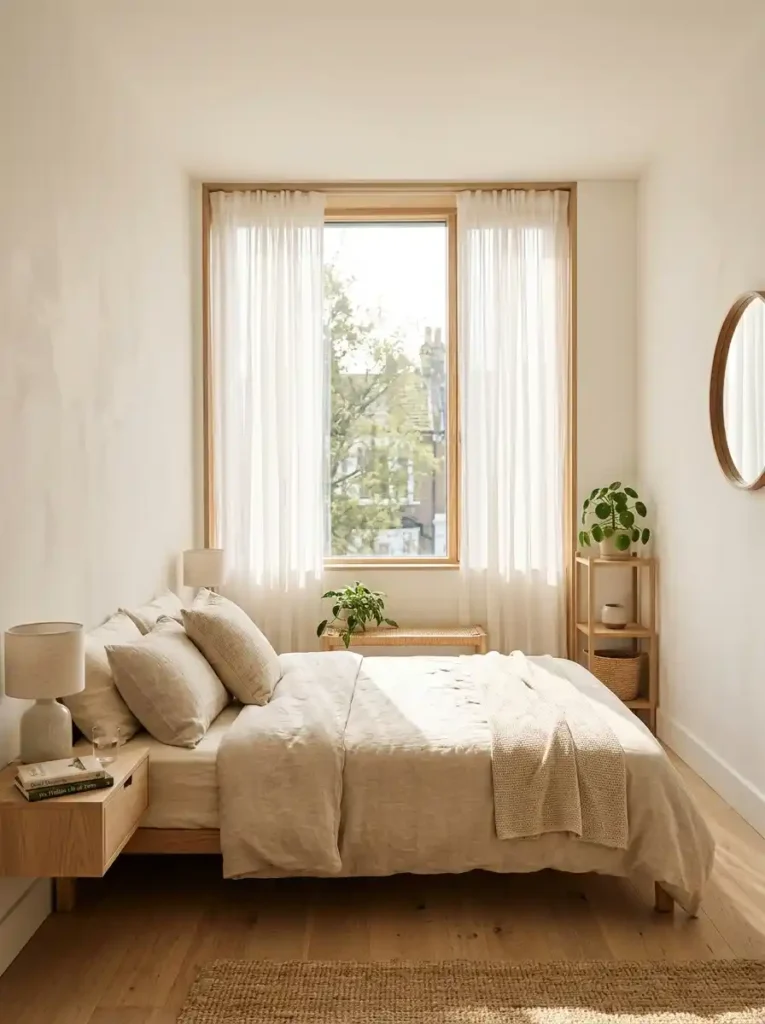
Less clutter equals less distraction, which leads to better sleep. Think of your bedroom as a quiet retreat, not a storage room. The mechanism behind this is well-documented: visual complexity requires cognitive processing, and a bedroom full of visible clutter maintains a low level of mental activity that works against the transition to sleep.
This applies most strongly to the immediate sleep zone — the bed, nightstands, and the walls and floor in direct sightline from the pillow. Cluttered shelves directly across from the bed, overloaded nightstands, and clothing left on chairs or floor create the kind of visual noise that the brain doesn’t fully switch off from.
The practical approach is hierarchy: the sleep zone gets the strictest editing, and storage elsewhere in the room can be more functional. Nightstand surfaces with one lamp and one other item maximum. No visible cables. Clothing with a designated home — a hook, a basket, a drawer — so it doesn’t default to the nearest surface.
7. Use Symmetry to Quiet the Visual Field
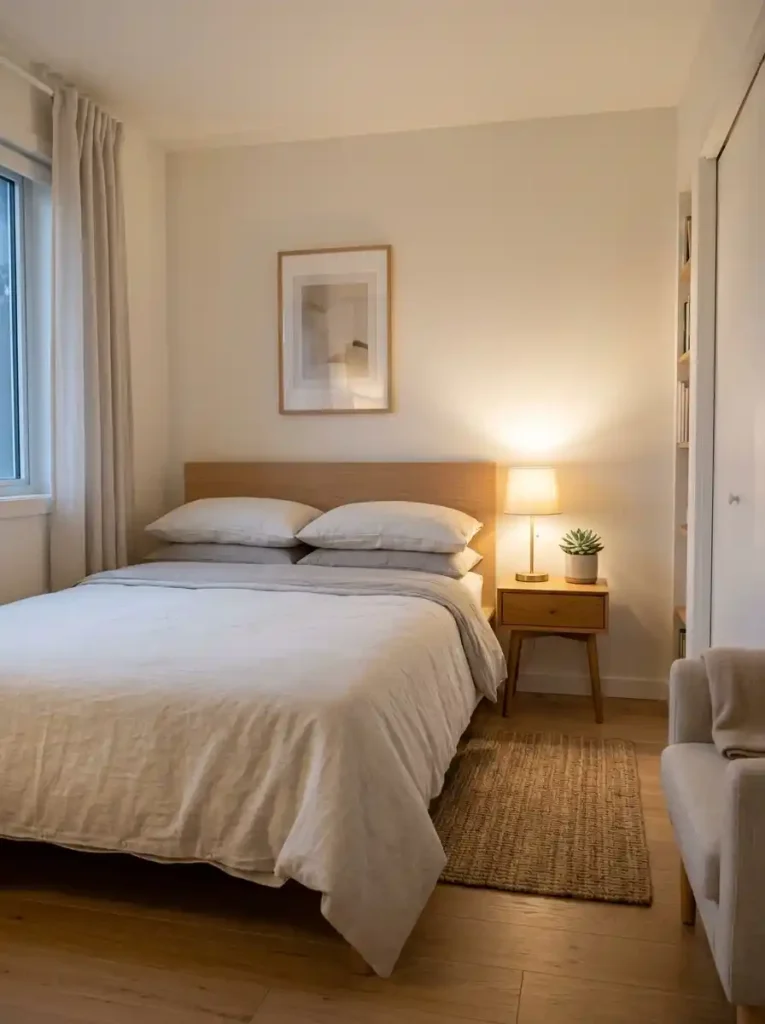
Scientific research suggests that symmetry and balanced sightlines improve the feel of the space — and this shows up practically in how calm a bedroom feels before sleep.
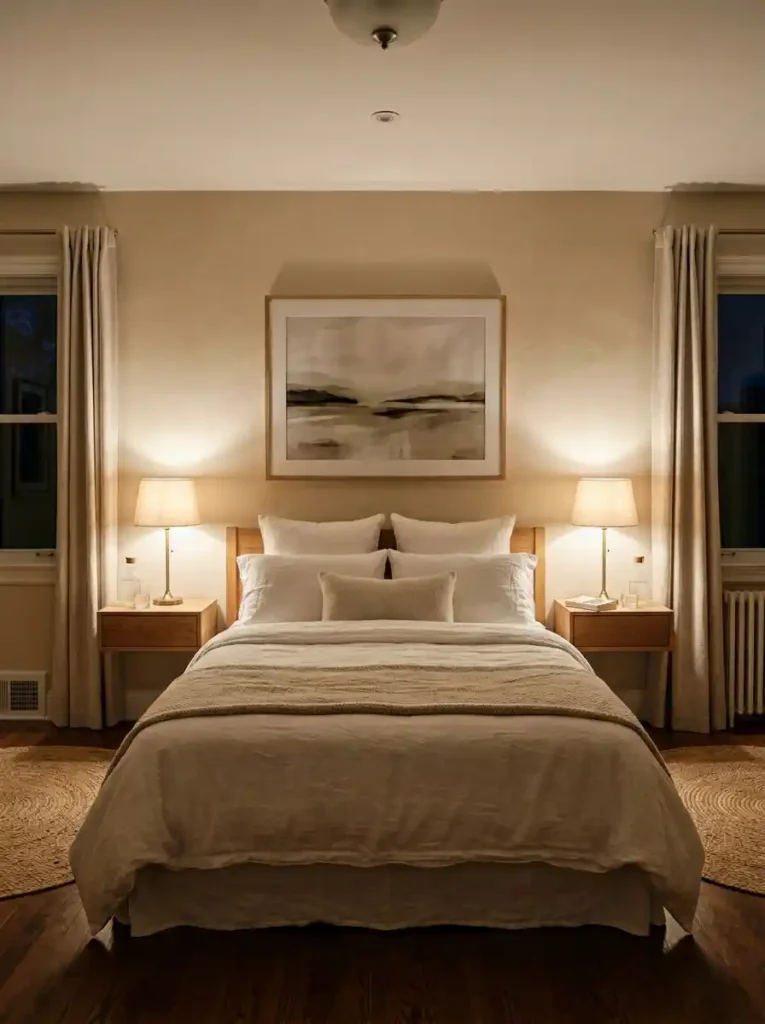
A balanced bedroom layout reduces what designers call visual decision points — the number of distinct things the eye registers and processes as it moves around the room. A symmetrical layout, with a centered bed and matching lamps on each side, gives the eye a clear and settled path that requires less cognitive processing than an asymmetrical arrangement with competing focal points.
For a small bedroom, the minimum symmetry requirement is: bed centered on one wall, an identical or near-identical light source on each side, and roughly equal clear floor space on both sides of the bed. The rest of the room’s layout can vary without undermining the effect.
8. Keep the Bed Away From Direct Door Alignment
This is related to the command position principle but addresses a specific version of the problem: a bed placed directly across from the door, fully in line with the opening.
A bed positioned away from the door but where the door can be easily seen — adhering to principles of safety and subliminal reassurance — along with minimalistic design approaches that reduce clutter, enhances feelings of calm and order essential for a peaceful night’s rest.
The distinction matters in small bedrooms where the command position can be hard to achieve perfectly. The goal is sightline to the door, not direct alignment with it. Even a bed placed at a slight angle, or shifted enough that the head isn’t directly in line with the door opening, creates the psychological sense of shelter that supports rest — without requiring a full room rearrangement.
9. Choose Softer Furniture Silhouettes Around the Bed
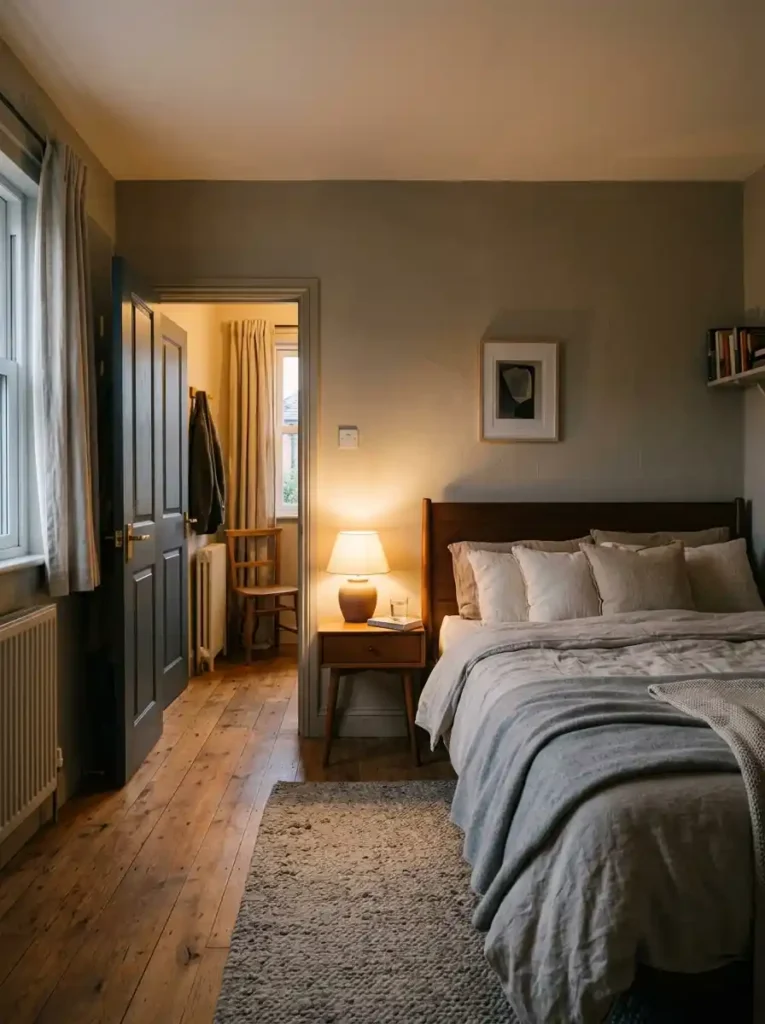
The furniture immediately surrounding the sleeping area contributes to the visual atmosphere the brain is processing in the minutes before sleep. Hard-edged, sharp-cornered pieces in close proximity to the bed create a subtly more alert visual environment than rounded or upholstered alternatives.
A 2024 study in Environmental Psychology showed that participants in “cocoon-like” rooms — with soft textures, rounded forms, and enclosed atmospheres — fell asleep 17 minutes faster than those in standard bedrooms.
In practice this means: an upholstered headboard rather than a hard wooden frame, rounded nightstands over sharp-cornered ones, and soft textiles — linen bedding, a wool throw, a jute rug underfoot — that add tactile warmth to the immediate sleep zone. Tactile input from soft materials activates the vagus nerve, which promotes the parasympathetic nervous system response associated with calm and rest.
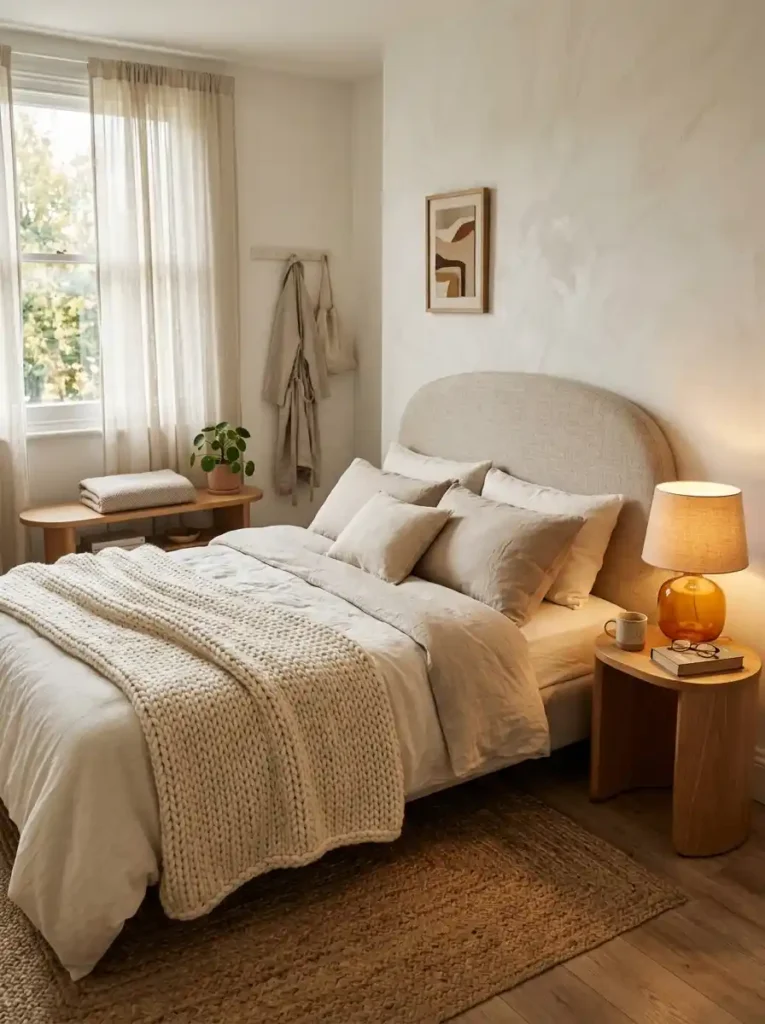
10. Leave Deliberate Empty Space Near the Bed
Filling every available corner and surface in a small bedroom maximizes storage while minimizing the sense of rest. The sleeping area specifically benefits from restraint — visible space near the bed signals that the room is for rest rather than activity.
Even a small layout adjustment to furniture placement, light, airflow, and textures can make nights more restful, and one of the most consistently underused adjustments is simply removing one item from the sleep zone rather than adding something new.
The most practical application: leave the floor beside the bed completely clear. No bins, no baskets, no extra pillows — just open floor. It improves nighttime movement, reduces visual stimulation in the area the brain processes last before sleep, and makes the room feel measurably calmer without changing any other element.
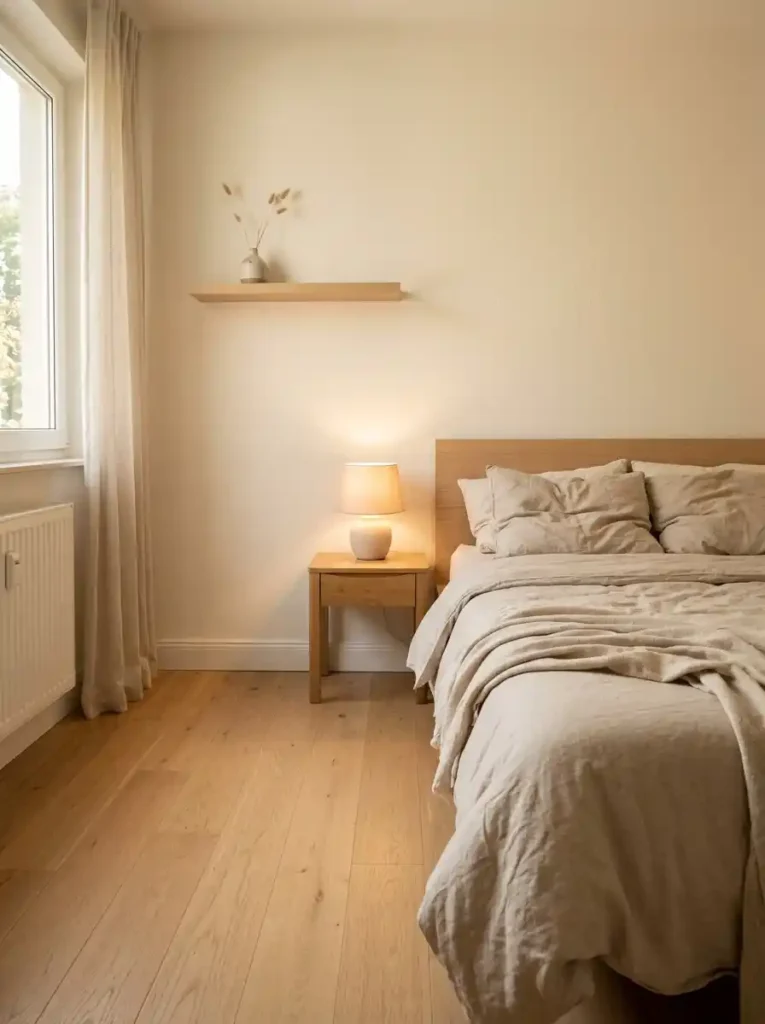
11. Design the Layout Around Sleep, Not Around Storage
This is the principle that all ten of the previous points lead back to.
Most small bedroom layouts are designed around the question of how to fit everything in. The furniture is chosen for its storage capacity, placed wherever it fits, and the remaining space is used for sleeping. The room functions as an organized storage unit that also happens to contain a bed.
The layouts that actually support rest are designed the other way around. The bed is the focal point. Furniture is arranged to maximize natural light during the day while maintaining the right conditions for sleep at night. Clutter is minimized and electronics are kept out of reach to promote relaxation.
A 2025 narrative review in Indoor Air synthesized evidence from peer-reviewed studies across 2000 to 2024, finding that thermal conditions, lighting, noise, and air quality all directly affect sleep quality — and that these factors are all shaped, at least partly, by bedroom layout decisions. Temperature regulation, light exposure, and airflow are all downstream of where furniture is placed and how the room is organized.
A bedroom designed around sleep doesn’t need to sacrifice function. It just needs to treat rest as the primary constraint rather than an afterthought.
Final Thoughts
The research on bedroom environments and sleep quality points consistently in one direction: the physical space you sleep in matters more than most people treat it, and the most impactful variables are layout decisions rather than product purchases.
Bed placement in a commanding position that feels settled and secure. Clear floor paths that make nighttime movement effortless. Warm-toned lighting that supports melatonin production rather than suppressing it. Visual calm in the immediate sleep zone. Unobstructed airflow. Separation from work cues.
None of these require a renovation or a significant budget. They require a clear-eyed look at whether the current layout is organized around convenience and storage — or around the thing the bedroom is actually there for.
Start with the bed position. Get that right first, then work outward. Most compact bedrooms improve significantly with two or three intentional changes made in the right order.